Amalfi Coast
Amalfi Coast Travel Guide
What the coast actually is, which towns earn your time, and how long a first visit really needs.
On this page
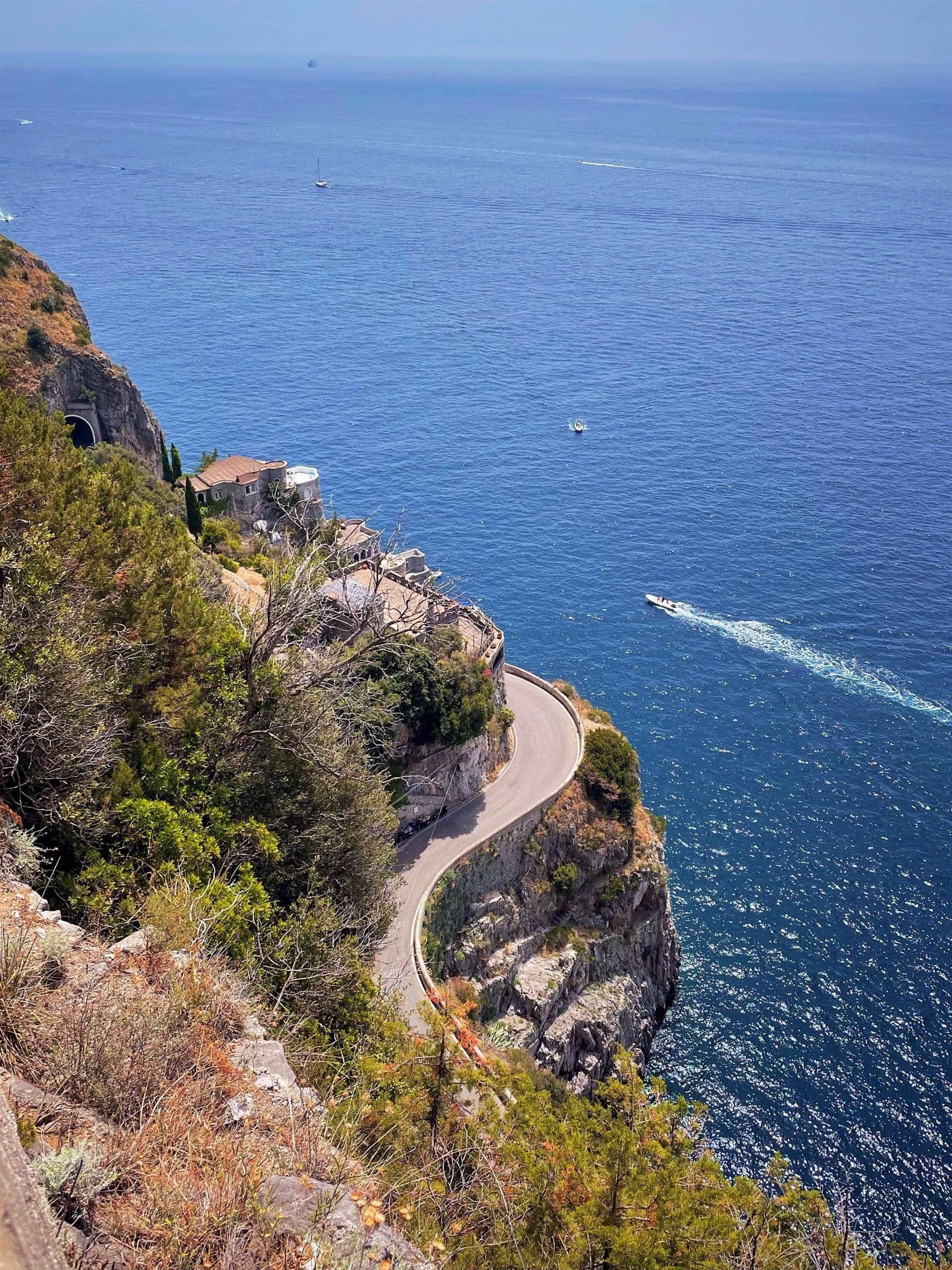
The Amalfi Coast is smaller than its reputation and slower than its map. It is about fifty kilometres of cliff on one side of one peninsula, threaded by a single road that was not built for the traffic it now carries, and the distance between two towns tells you almost nothing about how long it takes to travel between them.
That is the whole problem, and most of the advice about it is the wrong shape. The question is not which sights to tick off. It is how much of this coast you can reach in the time you have, which towns are worth the reaching, and whether the famous ones are the ones you actually want.
What the Amalfi Coast actually is
The Sorrentine Peninsula sticks out west into the Tyrrhenian Sea, with the Lattari mountains running down its spine. That ridge divides two coastlines. North of it is the Gulf of Naples. South of it is the Gulf of Salerno — and the southern side is the Amalfi Coast.
It is a UNESCO World Heritage site, inscribed as the Costiera Amalfitana: roughly eleven thousand hectares across fifteen municipalities in the province of Salerno, taking in Amalfi and Atrani, Positano and Praiano, Cetara and Erchie, the hill towns of Ravello, Scala and Tramonti, and hamlets like Furore and Conca. The listing covers farmed terraces and nature reserves as well as towns, which is the clearest signal of what the place actually is: a cultivated landscape people have been building into a cliff for a very long time, not a resort strip.
Four places are routinely folded into “the Amalfi Coast” and none of them is on it. Getting this straight before you book is worth more than any other single thing on this page, because each one implies a different journey.
Sorrento faces the Gulf of Naples on the opposite side of the peninsula, in a different province. It can work as a base outside the Amalfi Coast, with onward journeys by road over the ridge or, when services operate, by ferry. Check those connections for your dates before choosing it for an Amalfi Coast stay — the sailings that make it convenient in summer are thinner in winter. If a listing says Amalfi Coast and the address says Sorrento, the journey is part of what you are booking.
Capri is an island off the peninsula’s tip. It is reached by boat and it is a separate decision, which we come back to below.
Naples is a large city an hour or so away and the region’s gateway. Salerno is a working port city at the coast’s eastern end, on the national rail network, and a practical place to connect between trains and coastal ferries. Neither is a coastal village and neither should be planned as one.
How long the coast needs
Three full days for a first visit. That is enough for one base, two other towns properly, and a day that is not spent moving. It is also the point at which the coast stops being a photograph you visited and starts being a place you were in.
Two days is a real visit with a narrower brief. You can still reach a third town — the boats and buses do not stop you — but something gives, and it is usually depth: the second and third places become an hour each rather than an afternoon, and the unhurried evening that makes this coast worth the journey gets spent in transit instead. Two days works best if you decide in advance which one place you actually came for and let the rest be scenery.
A single day depends entirely on where it starts. From Sorrento, Naples or Salerno, a day on the coast is a genuine if limited introduction — one town properly, a crossing by boat, and back. From Rome it is a different proposition: most of the day goes on the journey, the middle of it lands when the road and the towns are fullest, and it ends before the evening that is arguably the point. We would not plan a day trip from Rome around this coast. A short visit from nearby is a fair introduction. It is not the same trip as three days, and it is worth being clear with yourself about which one you are taking.
Four or five days changes the trip qualitatively rather than quantitatively. It buys the walking — the terraces, the stairs between villages, the Sentiero degli Dei — and it buys the ability to lose a day to weather without losing the visit. On a coast where the boats depend on the sea and the road depends on the season, a spare day is not slack. It is insurance.
How those days are actually spent — which town on which morning, and in which order — is a separate question from how many of them you need. It belongs to the Amalfi Coast itinerary.
What each town is actually for
The towns are not interchangeable and they are not ranked. Each is good at something specific, and the useful question is which of those things you came for.
| Town | What it is for | Base? |
|---|---|---|
| Positano | The view, the vertical town, and the one beach most people picture. Small, steep and busy. | Yes, with stairs |
| Amalfi | A relatively level centre, the cathedral, and the coast's best-connected town by sea and road. | Yes, easiest |
| Ravello | Gardens and altitude. Quiet, cultured, and looking down on everything the others queue for. | Yes, if you want calm |
| Atrani | A small square and a beach a few minutes on foot from Amalfi, on a much smaller scale. | Visit, mostly |
| Praiano | Sunsets and quiet, between Positano and Amalfi, with less to do and fewer people doing it. | Yes, if you have a plan |
| Minori and Maiori | Level seafronts, easy beach access and ordinary Italian seaside life east of Amalfi. | Yes, underrated |
The last column is a summary and nothing more. Choosing between these towns as a base is a decision with enough in it to need its own page, and it has one: Where to Stay on the Amalfi Coast sets Positano, Amalfi and Sorrento against each other properly. What follows here is what each place is like when you are in it.
Positano
Positano is the image everyone arrives with, and it delivers on it. Houses in faded pink and ochre stacked in tiers down a ravine to a grey pebble beach, the tiled dome of Santa Maria Assunta in the middle of it. The town is genuinely beautiful and genuinely small, and both facts matter.
What people underestimate is the vertical. Positano is a cliff with a town on it; almost every journey within it is stairs, and the walk back up from the beach in August is a real piece of exercise. It is at its best early and late, before the day boats and after them. If you want the view and are prepared to climb for it, this is the place. If stairs are a problem, be honest about that before booking, because nothing about the town’s layout is negotiable.
Amalfi
Amalfi is the practical one, and that is a compliment. Its central area is relatively level by the standards of this coastline, its harbour is busy, and it is where the buses and boats converge — which makes it the easiest place to be based if you intend to move around.
It also has the coast’s major historic landmark. The cathedral rises above the main square at the top of a long flight of steps, and its striped facade and Arab-Norman cloister are a reminder that Amalfi was an independent maritime republic trading across the Mediterranean. It is less photogenic than Positano and, we would argue, more interesting.
Ravello
Ravello is up. It sits high above Amalfi on the ridge, and the climb is the point: the town looks down on the entire coastline from a terrace of gardens. Two of them are the reason to come. Villa Rufolo’s gardens run out to a belvedere over the Gulf of Salerno; Villa Cimbrone’s path ends at the Terrazza dell’Infinito, lined with busts, looking at nothing but sea and sky.
Ravello is also the coast’s cultural centre rather than its party one. The Ravello Festival takes over Villa Rufolo for a stretch of the summer with concerts staged on the garden terrace, and during it the villa’s ordinary closing time can move — worth checking on the day if the gardens are the reason you came. Of the three well-known towns, Ravello is the one we would tell you to give an unhurried half-day rather than an hour between buses.
The quieter towns
Atrani is a few minutes on foot around the headland from Amalfi and feels like a different coast: a small square, a beach, washing lines above it, and a scale that has more in common with a village than with its neighbour. It is close enough to reach on foot from Amalfi and different enough to be worth the walk.
East of Amalfi, Minori and Maiori have level seafronts and beaches you can walk onto without first descending a cliff, which is not something every town on this coastline offers. Praiano, between Positano and Amalfi, is smaller than either and angled for the sunset. Cetara is a working anchovy port. None of these is a compromise. They are the same coast at a different pitch, and travellers who want a place to be in rather than a place to photograph often prefer them — though we would not promise anyone empty streets in August.
Is Capri part of this trip?
Treat it as a separate decision, not an add-on. Capri is an island in the Gulf of Naples, off the tip of the peninsula. It is not on the Amalfi Coast, it is reached only by boat, and it is expensive in a way the mainland coast is not uniformly.
Done as a day trip from the coast, Capri is a long day built around two crossings, and the middle of it lands in the window when the island is at its busiest with day visitors from every other direction. It can be very good — the Giardini di Augusto, the chairlift up Monte Solaro, Anacapri away from the Piazzetta — but the version most people get is the crowded one, and the boat schedule decides the shape of the day rather than you.
Our position: if you have three days on the coast, spend them on the coast. If you have five, Capri earns one, and it is better with a night on the island than as a return crossing. If Capri is the thing you actually want to see, plan the trip around Capri and treat the Amalfi Coast as the addition — that is a better trip than doing both badly.
The road, the boats, and whether to bring a car
The coast has one through road, the SS163, and everything about moving here follows from its width. Anas, which manages it, has restricted categories of heavy vehicles, buses and caravans along the stretch between Positano and Vietri sul Mare, citing the road’s curves and a carriageway that in places is under six metres across. That is the physical fact underneath every piece of advice about driving here.
Our recommendation for most first visits: do not bring a car. That rests first on the ordinary conditions. The road is narrow, slow and busy; parking in the towns is scarce; the places you would drive between are linked by buses and boats that do not have to be parked; and the towns themselves are walked rather than driven. Those constraints apply whatever the season and whatever any ordinance says.
The plate scheme is an additional consideration rather than the whole argument, and its scope is narrower than it is usually reported. On specified dates the comuni restrict the SS163 by number plate: during the applicable hours, cars whose final numerical plate digit matches the parity of the date are barred — even final digits on even-numbered dates, odd on odd — subject to the exemptions below. The restriction applies only between stated hours in the middle of the day. Outside those hours, this alternating-plate restriction does not apply. It is set by ordinance and renewed each year, and the 2026 calendar is published: spring holiday periods, weekends and holidays through June and July, every day in August and September, and weekends again in October. It is not a continuous, coast-wide ban on tourist driving, and it should not be described as one.
What it does add is a specific inconvenience worth knowing. Guests of hotels and other accommodation holding a booking are exempt for the journeys needed to arrive and depart, which is not the same as being exempt for the day out you wanted the car for. Residents, taxis and accessible-badge holders are exempt more broadly. On a restricted date, a car you drove here in may simply sit between those hours.
There is a narrower exception. A car can make sense when your accommodation or itinerary lies away from the towns well served by ferries and buses, or when you are travelling in a quieter period and have confirmed parking. Being outside the alternating-plate calendar removes that restriction; it does not remove the road’s width, traffic or parking constraints. Treat this as a route-specific choice, not the default.
Boats are the good news, with two caveats. Travelmar, one of the operators serving this coast, describes its service as available all year round. That is a statement about the company rather than a guarantee that every town is served on every date, and the published timetables change through the year — some routes and stops appear only for the summer season. So the blanket claim that the coast shuts down out of season is not supported; neither is the assumption that a particular crossing will be running when you want it. Check your exact route and travel date against the operator’s own timetable rather than against any general statement, this one included.
The second caveat is the sea. Travelmar’s conditions of transport reserve the right to change departure and arrival times without prior notice and to cancel or alter a scheduled trip, and they disclaim responsibility for delay or cancellation caused by adverse weather and other matters beyond the company’s control. None of that is unusual for a coastal ferry. It is the reason a plan in which one specific crossing has to happen is more fragile than a plan that does not — another argument for the spare day.
With those caveats, travelling by sea can be the better option when the relevant sailing operates: it avoids road traffic and the alternating-plate restriction, and the coast is particularly legible from the water. Check the exact route and date before building the day around it.
Lines, tickets, timetables, the SITA buses, transfers from the airport and where you can actually park are a subject of their own, and they are getting their own page: Getting to and Around the Amalfi Coast.
What to book, and what to leave loose
Less than you would think. This is not Rome, where three separate ticketing systems decide the shape of your days. The coast’s constraint is beds and boats, not entry slots.
Book accommodation first, then reserve the experiences that matter to you. Leave ordinary sightseeing flexible. Where you sleep determines more about this trip than any other decision, and choice narrows during busy periods — which is why it has a page of its own in Where to Stay on the Amalfi Coast.
After that, the distinction worth drawing is between arriving somewhere and reserving something. Walking into Ravello’s gardens is the first kind: Villa Rufolo’s own admission notice says a reservation is not necessary for ordinary entry. A concert in the same gardens is the second kind entirely — the Ravello Festival stages its programme on the Villa Rufolo belvedere, tickets are sold in advance, individual dates sell out, and concert admission is separate from garden admission. If a particular performance is part of why you are coming, book it before you book anything around it.
Beaches work the same way. Reaching the public shore at Positano, Minori or Maiori needs no arrangement at all. Hiring a sunbed or spending the day at a beach club is a paid service with limited capacity: the Arienzo club below Positano, for instance, advises reserving through its own site and says it cannot guarantee space for walk-ins, opens seasonally, and is reached either by its shuttle boat from Positano or by around three hundred steps. If a specific beach club is part of the picture in your head, arrange it ahead. If any patch of sea will do, do not.
Everything else — the cathedral at Amalfi, the towns themselves, wandering — stays flexible, and should. Building a schedule around things that do not require one is how people end up rushing between places they could simply have arrived at.
The walking needs planning too, mostly for how you get to it and back. The Sentiero degli Dei runs the ridge from Bomerano, above Agerola, to Nocelle above Positano. The Club Alpino Italiano records it at 5.3 km, grade E, with a walking time of two hours in the outbound direction. Allow nearer three for photographs, a pause at the Colle la Serra saddle and the pace people actually walk it at; that allowance is ours, the two hours is the CAI figure.
Grade E is a mountain hike, not a country walk. The classification covers uneven ground — paths across rock, scree and open hillside — and can include steep slopes and exposed sections, which on this route means stretches with a long drop to one side. It does not call for ropes or technical skill, and it does call for proper walking shoes, sure footing, a head that is comfortable with height and enough fitness for a couple of hours of uneven climbing and descending. Grade E means achievable for a reasonably fit walker. It does not mean suitable for everyone.
The trail ends at Nocelle, and what happens after that is a separate decision rather than the last stretch of the walk. The comune of Agerola describes, as an alternative, a staircase of some 1,700 steps running down from Nocelle’s small square to Arienzo on the old coast road, and from there roughly another 500 metres into the centre of Positano. The local bus down from Nocelle is the other option, and taking it does not mean you did not walk the Sentiero degli Dei.
Grade and distance are settled; access is not. Sections can close after bad weather, so check current notices from Agerola or the trail authorities close to the day — and check those rather than other walkers’ accounts from an earlier season, which describe the path as it was, not as it is.
An organized tour earns its place when it solves a real logistical problem: reaching the start of the Sentiero degli Dei and returning from its end, visiting hill villages poorly served by regular transport, or arranging a boat day that would otherwise require several separate connections. For the principal towns, independent travel usually gives you more control over timing; a guided or private option can still make sense when mobility, comfort or a short time window matters. The point is to pay for a problem being solved, not simply to follow the same coast road on someone else’s schedule.