Skip to content
MenuClose

Amalfi Coast

Where to Stay on the Amalfi Coast

Positano, Amalfi or Sorrento — what each one costs you in stairs, transport and money, and which to choose for a first visit.

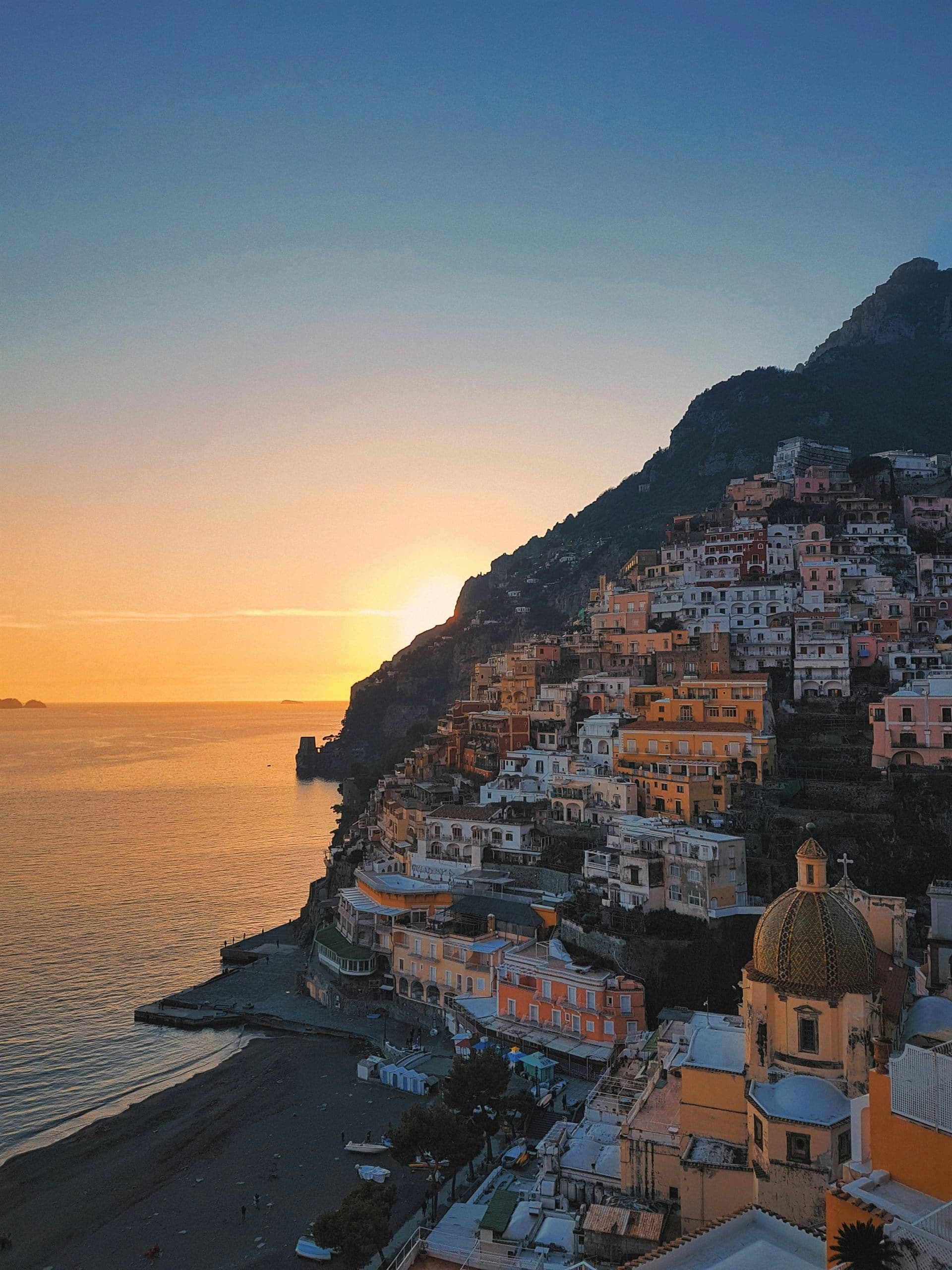
Positano at sunset, its houses stacked in tiers up a steep cliff above a dark grey beach, with the majolica-tiled dome of Santa Maria Assunta in the foreground.
Positano, and the reason the question is hard: the town is a cliff face.
On this page

Almost everyone arrives at this question with the same three names, and one of them is not on the Amalfi Coast. Sorrento sits on the other side of the Sorrentine peninsula, facing Naples and Vesuvius across the bay. It is a forty-minute bus ride and a mountain away from the coast road most people are picturing.

It still belongs in the comparison, because a great many people base themselves there on purpose and are right to. But the reason is practical rather than scenic, and knowing that before you book is the difference between a good decision and a disappointed one.

What follows is the decision, not a survey. Three towns are treated properly, three more get a shorter answer, and one is here to be talked out of.

The short answer

If you are visiting the Amalfi Coast for the first time, without a car, and you want one base for three or four nights, stay in Amalfi. It is the only one of the three that combines a position on the Amalfi Coast, a mostly level centre, and buses and ferries leaving from the same waterfront square.

  • Most first visits, no carAmalfiCentral, walkable, and the transport hub for the whole coast. The least dramatic of the three to look at, and the easiest to actually use.
  • Two or three nights, the setting is the pointPositanoThe most beautiful place to wake up on this coast, and the most physically demanding. Worth it for a short stay, if you have read the paragraph about the stairs.
  • A week or more, shoulder season, or arriving by trainSorrentoA working town with a rail line, flat ground and prices that are merely high. You are commuting to the coast rather than living on it, and for a longer trip that trade is often the right one.

What the choice turns on

Four things decide this, and only one of them is the view.

Vertical distance. This coast is a mountain that meets the sea without a shelf in between, and the towns are built up the slope in tiers connected by steps. That matters twice: once for every trip you make between your room and the water, and once, brutally, on the day you arrive with luggage. Ask any property how many steps stand between the nearest vehicle access and its door, and treat a vague answer as a bad one.

How you leave in the morning. The coast has one road, and it is narrow, winding and busy through the season. Ferries are pleasanter and often faster, but they are seasonal in frequency and they stop when the sea is rough — a cancelled crossing is an inconvenience if you are staying on the coast and a serious problem if you are not. A base with both options is worth more than a base with a better view.

What the town is like at nine in the evening. Day visitors leave. Some of these places become quiet and lovely; one or two become quiet and closed. Off season the difference sharpens, and smaller is not always better.

What you are actually paying for. Positano charges for the view and the address. Amalfi charges less for a similar standard. Sorrento has more rooms than either and therefore more competition. None of the three is cheap in summer, and the coast is one of the few places in Italy where moving one town along genuinely changes the number.

The six bases covered here, by the things that decide where you sleep.
BaseTerrainLeaving in the morningSuits
PositanoSteep — the town is a staircaseFerry in season, bus on the coast roadA short, scenic first trip where the setting is the point
AmalfiMostly flat at the centreFerries and buses from one waterfront squareMost first visits, and anyone without a car
SorrentoFlat, on a clifftop above its portDirect rail to Naples, then bus or ferry to the coastLonger trips, shoulder season, and reaching the region by train
PraianoSteep, spread along the roadBus; limited seasonal ferryA quieter, cheaper stay between the two coastal towns
SalernoFlat cityNational rail, plus ferries along the coastBudget, late arrivals and onward travel
Ravello350m above the sea, no shoreline of its ownBus down to Amalfi, then everything elseA view and a garden, not a base

The three main bases

Positano

Positano. The photograph everyone has seen, and the one town here where the thing you came for is visible from the room.

It is also a staircase. The historic centre is closed to cars, the town descends the cliff in tiers, and the connections between those tiers are steps rather than streets. A taxi or bus can bring you to the top or to the road; it cannot bring you to most front doors. That is why the town has a porter trade, and the existence of a porter trade is the most honest description of the terrain anyone can give you.

Plan around it rather than being surprised by it. A room high up buys the view and costs you a climb every time you want dinner or the beach; a room low down is closer to the water and further from the bus. Neither is wrong, but the choice is real, and it is worth more thought than the star rating.

The beach below is Spiaggia Grande. Most beaches on this coast are small and pebbly or shingly rather than broad stretches of soft sand, so bring something to put on your feet.

Choose it for two or three nights on a first trip, when the setting is the reason you are here and the walking is a fair price. Choose against it if anyone in the party has mobility limits, if you are carrying heavy luggage, or if you want a base for a week of day trips — for that, the stairs stop being scenery and become a commute.

Amalfi

Amalfi. The practical answer, and the one most first visits should take.

The town sits in a cleft in the cliffs rather than up their face, which means the centre is broadly flat: a cathedral square, a main street running inland from it, and the waterfront a few minutes away on the level. After Positano that is not a small thing. It is the difference between a town you look at and a town you can use.

Its real advantage is the waterfront. The bus terminal and the ferry piers are on the same square, which makes Amalfi the interchange for the whole coast — you can leave by road or by sea from one spot, and switch to whichever is running. On a coast where the sea cancels boats and the road jams, holding both options is worth more than any view.

What you give up is drama. Amalfi is a handsome town rather than a spectacular one, it takes more day visitors through its centre than Positano does, and the hour either side of the ferry arrivals is the busiest part of its day. It is also the obvious base for Ravello, which is a short bus ride up the valley behind it.

Sorrento

Sorrento. Not on the Amalfi Coast, and still the right choice for a particular kind of trip.

The geography first, because it is the thing people get wrong. Sorrento faces north across the Bay of Naples toward Vesuvius. The Amalfi Coast faces south. Between them is the spine of the peninsula, and getting from one to the other means the coast road over the pass — comfortably the longest daily journey of any base here.

What you get in exchange is a town that works. Sorrento is the terminus of the Circumvesuviana line from Naples, with trains through the day and a journey of a little over an hour, so you can arrive from Rome or Naples by rail and step off in the centre. It is flat, it has more hotels and restaurants than the coastal towns, and it stays open in shoulder season when Positano is shuttered. It is also the natural base for Pompeii, Herculaneum and Capri, which are all closer to it than to Amalfi.

Choose it for a longer stay, an off-season trip, a car-free arrival by train, or a trip where the Amalfi Coast is one thing you are doing rather than the whole point. Choose against it if you have three nights and came for the coast: you will spend a meaningful share of them getting to it and back.

Quieter alternatives

Two more are worth real consideration, for opposite reasons.

Praiano

Praiano. Between Positano and Amalfi, on the same road, and markedly quieter than either.

It is a village strung along the cliff rather than a town with a centre, so it is steep in the same way Positano is and has far less at the bottom of the steps. That is the whole trade: you get lower prices, an evening with almost nobody in it, and the same coastline — in return for depending on the bus and for a shorter list of places to eat.

It works well as a second visit, or as a first visit for people who would rather read on a terrace than walk through a town. It is a poor choice for anyone who wants to step out of the door and find something happening.

Salerno

Salerno. A real city at the eastern end of the coast, on the national rail network, and by some distance the cheapest way to sleep near the Amalfi Coast.

It is not scenic in the way the rest of this page is, and nobody comes here for the setting. What it offers is function: fast trains to Rome and Naples, ferries west along the coast in season, ordinary Italian city prices, and no difficulty at all arriving late or leaving early.

Worth it if the budget is the constraint, if you are arriving or leaving by train at an awkward hour, or if the coast is one stop on a longer Italian trip. Not worth it if you have three days and want to wake up on the coast, because you will be commuting to it every morning.

Better to visit than to sleep in

Ravello is the one place on this page we would actively steer a first-time visitor away from as a base, and it is also one of the best half-days on the coast.

It sits roughly 350 metres above the sea on the ridge behind Amalfi. It has no shoreline, no harbour and no ferry — the water you can see from its gardens is a bus ride down and a bus ride back, and the last bus is earlier than you would like. For a few hours in the gardens at Villa Rufolo and Villa Cimbrone that is irrelevant. For a base, it means every single thing you do begins with a descent and ends with a climb.

Stay in Amalfi and go up for the afternoon. You will see the same gardens, from a town you can leave.

Two more that get searched as bases and rarely deserve to be: Capri, where the day-visitor economy empties out in the evening and the prices do not, and Maiori, which has a broader, flatter beach than most of the coast and very little else within walking distance.

This page deliberately names no hotels. Which property, in which town, at which price is a different question with a different answer, and it gets its own page in Amalfi Coast Hotels. The decision above should hold whichever room you end up booking.