Skip to content
MenuClose

Florence

Things to Do in Florence

Which sights genuinely earn the time, what has to be reserved before you leave, and how long the city needs — from a place small enough that queueing is the only real risk.

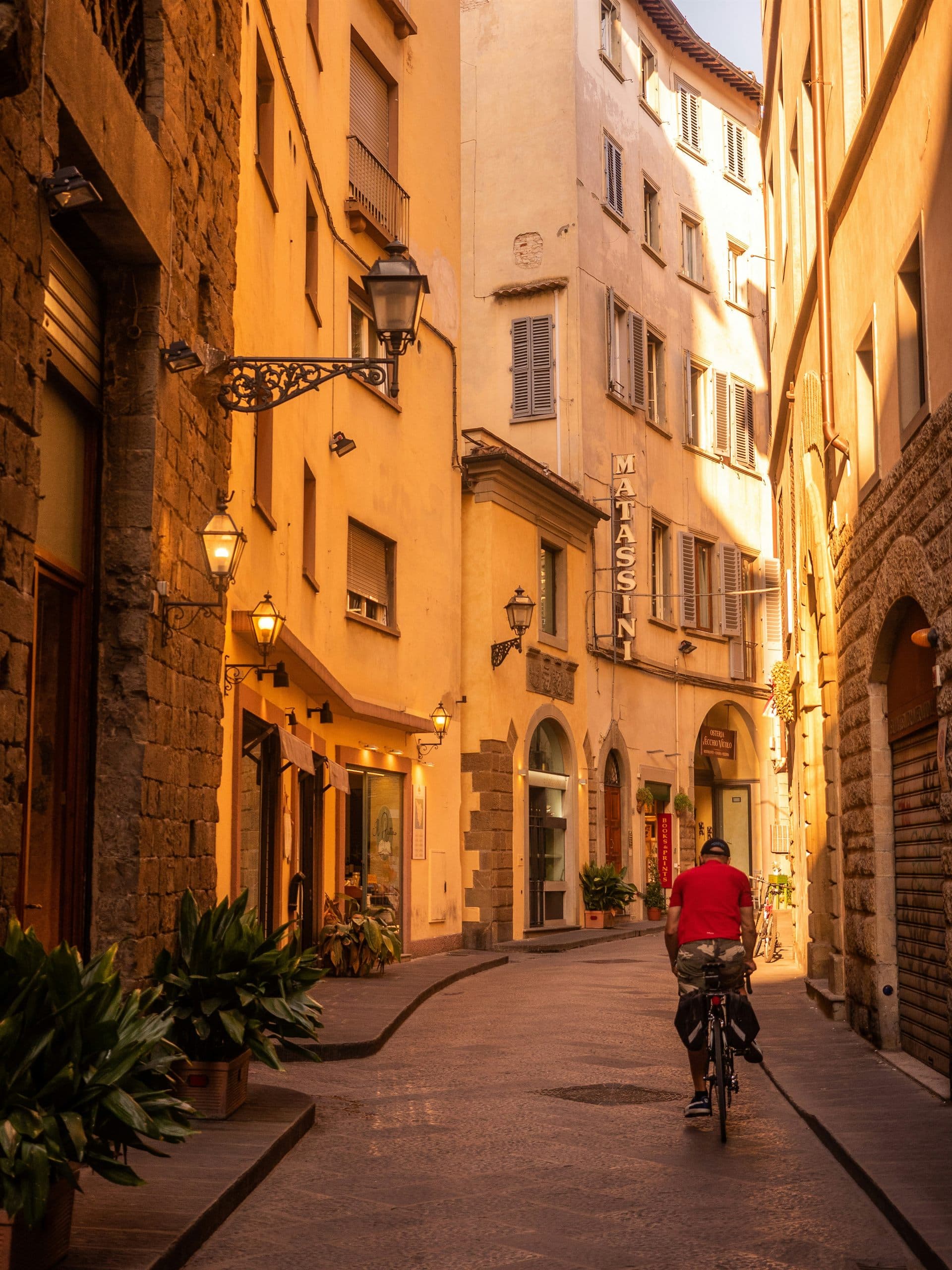
A narrow stone-paved street at golden hour between tall ochre buildings, iron lanterns on the walls, small shopfronts and an osteria sign, with a cyclist riding away from the camera.
Between the museums, this is most of Florence — and most of what makes it worth more than a day.
On this page

Florence is a small city carrying an enormous quantity of art, and almost all of it sits inside a walkable historic centre on the Arno. Nothing on this page is far from anything else. What separates a good visit from a frustrating one is not planning a route — it is deciding, before you arrive, which two or three things you are going to reserve.

That is the unusual thing about Florence among Italian cities. Rome rewards stamina and Venice rewards wandering; Florence rewards paperwork. Its headline sights run on timed entry, its two biggest museums close on the same day of the week, and the single most popular climb in the city cannot be done without a reservation at all.

So this page is organised around that: how long to give the city, what genuinely has to be booked, which sights repay the time, and which are more famous than they are rewarding.

How long Florence needs

Two full days. That is enough for the Duomo complex, one of the two great museums without rushing it, an afternoon in the Oltrarno and an evening that is not spent queueing. It is the length most first visits should plan for.

One day is common and is the source of most disappointment here. It can be done, but it forces a genuine either/or: the Uffizi or the Accademia, not both, and probably not the dome as well. If a single day is what you have, pick the one museum you actually care about, book it, and treat the rest of the day as walking.

Three days is where Florence stops being a checklist. The extra day buys the second museum, the smaller churches, and the thing most itineraries never reach — time on the south bank, where the city is a place people live rather than a collection.

Beyond three days the pull is outward rather than deeper. The countryside, Siena and Pisa are all close, and at that point the question stops being what else to see in Florence and becomes which days to spend outside it — which is a different question, covered in Day Trips from Florence.

What has to be booked

There is one hard requirement and several strong recommendations, and confusing the two is how people end up either standing in a long queue or paying a premium for a reservation they never needed.

The dome climb is the hard one. It runs on a compulsory timed slot with a limited number of places, and it is the single most-wanted experience in the city. Book it first, before flights are even confirmed if your dates are fixed, and build the rest of the day around the slot you get. Note also that it is a climb in the literal sense — several hundred steps, no lift, and no alternative route to the top.

The Uffizi and the Accademia are strong recommendations rather than requirements. Both run timed entry and both reward booking, particularly in high season; walking up is possible and sometimes fine in winter, and unpleasant in July. The scheduling fact that matters more than either is that they close on the same day: both are shut on Mondays, so a Monday-only visit to Florence loses both at once. If your dates include a Monday, spend it on the Duomo complex, the churches and the Oltrarno, and put the museums elsewhere.

Everything else on this page can be decided on the morning. Check current opening days on the official sites before you fix anything — the museums each keep their own calendar, and holiday closures move.

What genuinely needs reserving, and what does not.
WhatBook aheadNote
The dome climbRequired — timed slotThe one thing to book first; slots are limited
The rest of the Duomo complexOne pass, no time slotBaptistery, campanile, museum, crypt
The UffiziStrongly advisedTimed entry; closed Mondays
The AccademiaStrongly advisedTimed entry; closed Mondays
The Vasari CorridorRequired, separate ticketNot included in a standard Uffizi ticket
Palazzo VecchioRarely necessaryWalk-up usually works
Santa CroceNoTurn up
The Oltrarno and the marketsNoThe unbookable half of the city

The sights that earn the time

The Duomo complex

The Duomo complex. The best value of anything in Florence, and the thing to organise the trip around.

It is not one building but a set of them sold together: the cathedral, Brunelleschi’s dome, Giotto’s campanile, the baptistery, the crypt beneath the church and the Opera del Duomo museum. The pass covers the group across a few days, and the museum in particular is consistently underrated — it holds the original sculpture taken off the exterior, including work most visitors assume they are looking at outside.

The dome climb is the part with the constraint. A reserved time, an identity document, several hundred steps and no lift: it is not a casual add-on, and it is the one thing here that genuinely cannot be improvised. The campanile gives a comparable view with the dome itself in it, which the dome cannot offer — the same argument that applies to bell towers everywhere.

The Uffizi

The Uffizi. If you visit one museum in Florence, this is the one — a purpose-built Medici gallery holding the most concentrated collection of Renaissance painting anywhere.

It is also large, and the standard mistake is treating it as a corridor to be completed. Two to three hours with a shortlist beats four hours of dutiful walking. Go early or late in the day rather than at midday, and accept that you will walk past a great deal.

The Vasari Corridor — the elevated passage running from the gallery across the river — reopened after roughly a decade closed for restoration. It needs its own ticket, which a standard Uffizi admission does not include, and booking is compulsory with limited places. It is a genuinely unusual thing to walk, and it is also the most recently changed item on this page: confirm its current status and ticketing on the gallery’s own site before counting on it.

The Accademia and David

The Accademia. Worth going to, and the most over-weighted stop in Florence.

David is genuinely worth seeing in person. The scale does not survive photography, and the unfinished Michelangelo sculptures in the same hall — figures half-emerged from raw marble — are arguably the more interesting room. But this is a small museum built around one object, and it draws queues out of proportion to how long you will spend inside.

Treat it accordingly: book a slot, go in, give it an hour, and do not plan a day around it. If you are choosing between this and the Uffizi on a single-day visit, the Uffizi is the better use of the time unless David is specifically the thing you came for.

Palazzo Vecchio

Palazzo Vecchio. The civic heart of the city, still the town hall, and the most reliably under-visited major sight in Florence.

Where the Uffizi shows you what the Medici collected, this shows you how they governed — a fortified seat of government with a vast painted hall at its centre. It rarely requires booking, which after everything above is a relief, and the tower gives another view over the square.

The piazza outside is free and open, and the sculpture in the loggia beside it is a genuine open-air gallery that most people walk through without stopping.

Beyond the headline sights

Four things that need no reservation and that most two-day visits skip. They are also, collectively, the difference between having seen Florence and having been there.

Santa Croce

Santa Croce. A Franciscan church on the eastern side of the centre that functions as the city’s pantheon — Michelangelo, Galileo and Machiavelli are among those buried or commemorated inside.

It takes an hour, it needs no booking, and it is the best single antidote to museum fatigue: frescoed chapels, a large cloister, and a quiet that the Duomo no longer has.

The Oltrarno

The Oltrarno. The south bank, across the river, and the half of central Florence that has not been given over to visitors.

Artisan workshops still work here — gilders, framers, leather and paper — alongside the churches, the Brancacci Chapel frescoes and the piazzas that fill up in the evening rather than at noon. Cross a bridge and the volume drops within a couple of streets.

Give it an afternoon and, if you can, an evening. It is also the strongest argument for where to sleep, which is the subject of its own guide below.

A view over the city

A view over the city. Florence is ringed by hills on the south side, and the walk up to the terraces above the Oltrarno is the one free thing here that competes with the ticketed sights.

It puts the whole centre in one frame — the dome, the campanile, the tower of Palazzo Vecchio and the river — and it costs a climb rather than a reservation. Go towards the end of the day. The church higher up the same hill is worth the extra few minutes of ascent and is usually far quieter than the terrace below it.

Markets and eating

Markets and eating. Florence is a Tuscan city before it is a museum city, and its food is regional and specific rather than generically Italian.

The central market is the obvious entry point and worth an hour, though the upper floor is now firmly a food hall for visitors. The more useful habit is to eat away from the sights: the streets around Santa Croce and most of the Oltrarno are where the ratio of locals to tourists changes.

Avoid anywhere with a photographic menu, a person outside inviting you in, or a view of the Duomo. Those three filters remove almost every bad meal available in the city centre.

Where to base yourself

The centre is compact, so this is a question about noise and atmosphere rather than distance. Two short answers: for a first visit, the historic centre south of the Duomo, which is central without being in the blocks that empty out at night; for evenings and a second visit, the Oltrarno.

Two things not to do: book immediately beside the cathedral expecting it to be lively after dark, and bring a car into the centre, which is a restricted-traffic zone with automatic fines.

The full comparison — six areas, what each costs you, and where not to book — is in Where to Stay in Florence.