Skip to content
MenuClose

Florence

Where to Stay in Florence

Florence’s historic centre is compact enough that the decision is usually about atmosphere, noise and luggage rather than long daily journeys. Six areas, and which one suits a first visit.

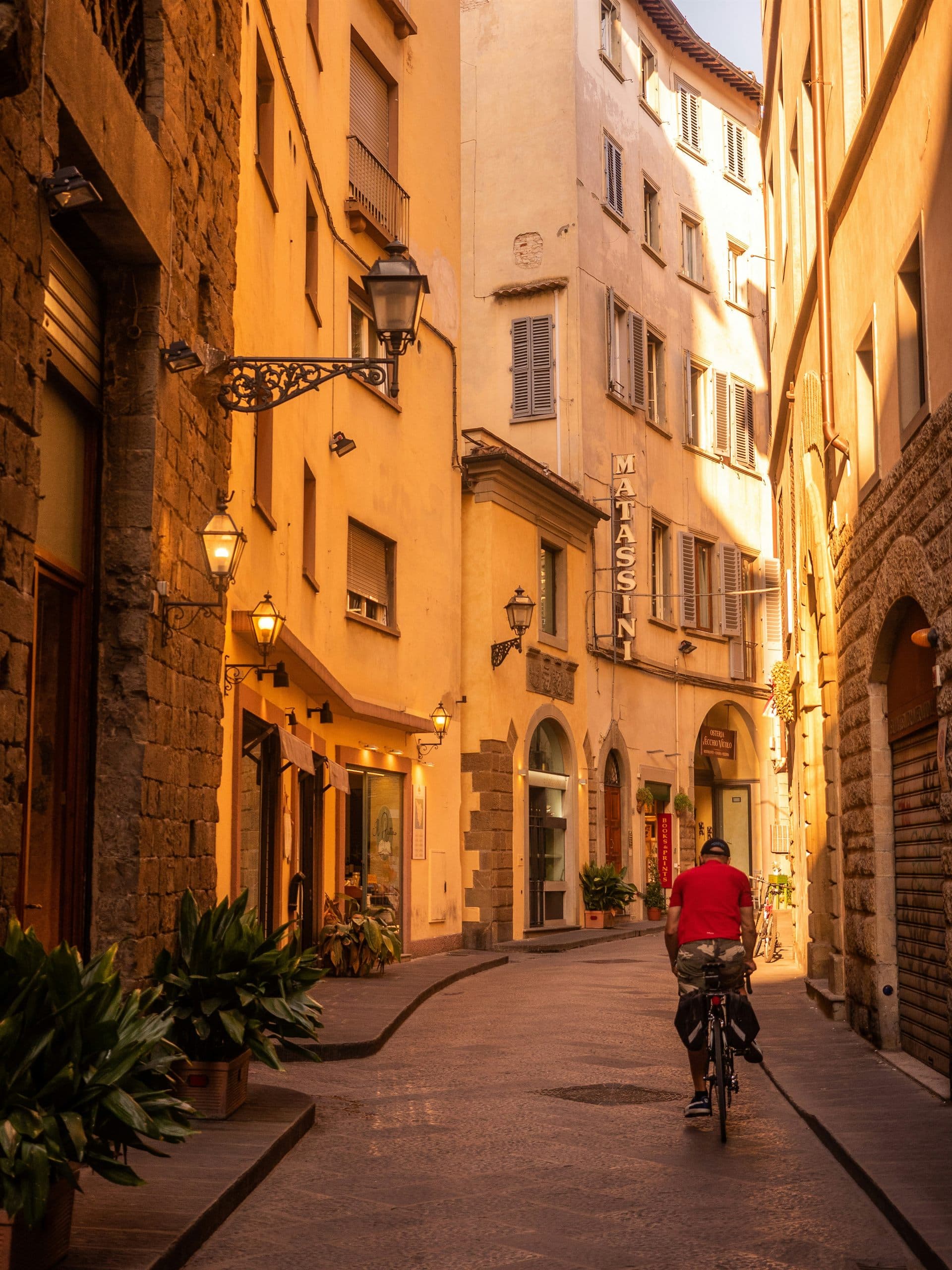
A narrow stone-paved street at golden hour between tall ochre buildings, iron lanterns on the walls, small shopfronts and an osteria sign, with a cyclist riding away from the camera.
The scale of the centre is the point: almost all of it looks like this, and almost all of it is walkable.
On this page

Florence — the Tuscan one, on the Arno, with Brunelleschi’s dome over it — has a historic centre compact enough that the accommodation decision is usually about atmosphere, noise and luggage rather than long daily journeys. Both banks of it are inscribed as a single UNESCO World Heritage site, and almost everything a first-time visitor comes for sits inside that area.

That changes the question. In a large city, where you stay decides how much of your day you spend travelling. Here it does not. Every area below is walkable to the Duomo, so the choice is about what your street is like at ten at night, what you pay for the address, and whether you want to cross a bridge to get home.

Six areas are covered. One of them is the answer for most people, one is the answer for a specific kind of trip, and one is on the list mainly so you can decide against it on purpose.

The short answer

For a first visit, stay in the southern half of the historic centre — the streets between Piazza della Signoria and the river, rather than the blocks immediately around the cathedral. You keep everything within easy walking distance, and you avoid the part of the centre that turns into a coach park by day and empties out entirely at night.

  • Most first visitsHistoric centre, south of the DuomoCentral without being on top of the cathedral. Everything on foot, and streets that still have ordinary life on them.
  • Arriving by train, or taking day tripsSanta Maria NovellaYou can walk to the platform with a suitcase, which on a trip built around Siena, Pisa or Bologna is worth more than a better view.
  • Atmosphere and eveningsThe Oltrarno — Santo Spirito or San FredianoThe side of the river where people still live and eat. Cross a bridge in the morning; come home to a neighborhood rather than a monument.
  • QuietSan NiccolòResidential, at the eastern end of the Oltrarno under the hill. The longest walk into the centre of any area here, and the calmest option on this page.

What the choice turns on

Noise, not distance. The centre is compact enough that walking times barely separate the options. What separates them is what happens outside your window in the evening — and in a city this dense, with stone streets and shuttered windows, sound carries. A room over a piazza with bars on it is a different holiday from a room two streets back.

Whether the street empties. Florence takes an enormous number of day visitors, and the blocks closest to the cathedral are the ones most given over to them. Those streets are at their most crowded at midday and their most lifeless at nine in the evening. Areas with residents behave the opposite way.

The station, if you are moving. Santa Maria Novella sits at the western edge of the centre, within walking distance of the Duomo. If your trip involves day trips by rail or an early departure, being able to reach the platform on foot with luggage is a real and underrated advantage.

The river, and the ground. The centre is flat. The Oltrarno is flat along the river and then climbs sharply towards the hill behind it, so “in the Oltrarno” covers both an easy walk and a steep one — worth checking on a map before booking. Crossing the Arno costs you very little; the bridges are frequent and short.

Do not plan on driving. Most of the historic centre is a zona a traffico limitato — the ZTL you will see on signs and in hotel emails. It is camera-enforced, and entering it without authorization produces a fine that arrives by post weeks later. Hotels inside the zone can usually register your plate in advance, but that has to be arranged before you drive in, it is specific to that property, and the enforcement hours change. If you are renting a car for Tuscany, the sane pattern is to collect it when you leave Florence, not to bring it in.
The six areas, by the things that actually differ between them.
AreaOn footAfter darkSuits
Historic centre, south of the DuomoShortest — everything closeQuiet, and quite emptyMost first visits
Immediately around the DuomoYou are already thereEmptied of residentsShort stays that prize the doorstep
Santa Maria NovellaShort walk to the DuomoMixed, busier near the stationTrain arrivals and day trips
Santa CroceShort walkThe loudest optionEating and evenings, if noise is fine
Oltrarno: Santo Spirito and San FredianoA bridge, then a short walkAlive, and mostly localAtmosphere, second visits, longer stays
San NiccolòThe longest walk hereResidential and calmQuiet, and anyone happy to walk

The areas, one by one

The historic centre, south of the Duomo

The historic centre, south of the Duomo. The band of streets running down from Piazza della Signoria to the Arno, and the recommendation for most first visits.

It is central in the only sense that matters here — the Uffizi, the cathedral, the Ponte Vecchio and the river are all close by — without putting you in the two or three streets that absorb the worst of the day-visitor crush. There are still shops that sell things to people who live here, and restaurants that are not entirely staffed for tourists.

You pay for it. This is among the more expensive parts of the city to sleep in, and rooms in the older buildings can be small, dark and reached by stairs. Ask about the floor and the courtyard: an interior-facing room here is worth considerably more than a street-facing one.

Immediately around the Duomo

Immediately around the Duomo. The obvious choice, and the one this page would talk most people out of.

Waking up with the cathedral outside the window is a real thing and some people rightly want it. The trade is that these blocks are the most heavily touristed in Florence: busy and slow to walk through from mid-morning, and then, once the coaches have gone, oddly dead. You are paying a premium for a view and address that most visitors can reach within a short walk.

Worth it for a one- or two-night stay where the doorstep genuinely is the point. A poor use of money for anything longer.

Santa Maria Novella

Santa Maria Novella. The western edge of the centre, built around the basilica and the main station that borrows its name.

Its case is logistical and it is a strong one. The station is the hub for Siena, Pisa, Lucca, Bologna and the fast line to Rome, and staying within walking distance of it removes the single most annoying part of a multi-stop Italian trip: moving luggage. The Duomo is a short walk away, so you give up very little in return.

The area is not uniform. The streets around the basilica and towards the river are handsome and calm; the blocks directly behind the station are the least appealing part of central Florence, and they are noticeably cheaper for a reason. Look at exactly where a property sits rather than trusting the district name.

Santa Croce

Santa Croce. The eastern side of the centre, one of the oldest quarters of the city, and the one with the most going on after dark.

It has the best concentration of places to eat and drink of any area on this page, a large piazza that functions as a genuine gathering place, and enough student and local life that it does not switch off in the evening. Everything central is a short walk away.

The same quality is the caveat. This is the loudest place to sleep in Florence, particularly on and around the piazza and particularly at weekends. If you are a light sleeper, stay a few streets back from the square or choose somewhere else entirely.

The Oltrarno: Santo Spirito and San Frediano

The Oltrarno. Literally “beyond the Arno” — the south bank, inside the old walls, and the part of central Florence that still reads as somewhere people live.

It is not one place. Santo Spirito is the more polished and more visited half, built around a piazza that fills up in the evening and a church that is worth going into. San Frediano, west of it, is the more workaday one — artisan workshops, the Brancacci Chapel, fewer people who are only passing through. Both are a bridge and a short walk from the Uffizi.

This is the strongest choice on the page for anyone on a second visit, staying a week, or simply more interested in where they will eat than in what they can see from the window. The costs are honest ones: fewer big sights on your doorstep, a river crossing every morning, and — in the livelier corners of Santo Spirito — evening noise of its own.

San Niccolò

San Niccolò. The eastern end of the Oltrarno, tucked under the hill that climbs to the terraces above the city, and the quietest option here.

It is small, residential and largely undisturbed, with a short run of good restaurants and very little through traffic. It is also the closest base to the climb up to the viewpoints on the hill, which is the one thing in Florence genuinely worth being near rather than travelling to.

The trade is walking: the longest approach into the centre of any area here, and the streets going inland from the river start going uphill quickly. Good for a longer stay or a return visit, harder to justify on two nights.

Where not to book

Two patterns account for most Florence accommodation regrets, and neither is a neighborhood exactly.

Outside the walls to save money. Florence is small, so the ring of cheaper areas beyond the historic centre looks close on a map and is close — but the saving is usually modest and it buys you a walk, or a bus, at the end of every day. The compactness that makes the centre worth paying for is the same compactness that makes the discount small. Check the actual walking route before you take it.

A car, anywhere central. Covered above, and worth repeating because it is the most expensive mistake available here. If a property advertises parking, confirm exactly how you are meant to reach it and whether your plate will be registered before you arrive.

One more thing this page deliberately does not do: recommend individual hotels. Which property, in which building, at which price is a different question, and the area you choose should survive whichever room you end up in.