Skip to content
MenuClose

Florence

Day Trips from Florence

Which trips give you a day, which ones spend it getting there, and how far the train actually takes you.

On this page

Florence sits in the middle of the best-connected part of Italy, which is why every list of day trips from it runs to fifteen entries and why so many of those days go wrong. The problem is never that the places are not worth seeing. It is that a day trip is a fixed budget of about ten hours, and the difference between a good one and a wasted one is how much of that budget the journey takes before you have seen anything.

So this page is organised by the shape of the day rather than by how famous the destination is. Some of these are genuinely easy — one train, no changes, and you are there before the queues. Some need a connection that is fine once you have planned for it. One of them has no station at all and never will. And one is on every list of day trips from Florence and should not be.

Which day trips from Florence are worth the day

On a first visit with one day to spare, go to Siena. It is the only destination near Florence that is a complete place rather than a single sight — a walled medieval city with a day’s worth of things in it — and it is close enough that you arrive with the morning intact. Nothing else on this page combines those two things.

  • One day to spareSienaA whole city rather than one monument, and near enough that the day is spent there rather than on the way.
  • Two days, and you want varietySiena, then Pisa and Lucca togetherPisa is a famous half day. Lucca is what makes it a whole one, and the trains between them are direct.
  • You want the countrysideChianti or the Val d’Orcia, by roadThere is no station. This is the one day where a car or an organised trip is solving a real problem.
  • You have been to Tuscany beforeBolognaHalf an hour or so on a fast train, and a city most visitors to Florence never think to spend a day in.

The one to reconsider is Cinque Terre. It appears on almost every list of day trips from Florence, including in the title of this page, because that is what people search for. The honest answer is that it does not work as a day and is worth a night, for reasons set out below.

What actually decides a good day trip

The number of legs, not the distance. A single direct train an hour and a half long is a better day than a forty-minute train plus a bus plus a wait, because every change is a place the day can slip. It is also the thing a map does not show you: two destinations the same distance from Florence can be an hour apart in practice.

Whether the station is the destination. This is the detail that catches people out most often in Tuscany. Siena has a railway station, and it is roughly two kilometres north of the historic centre and a good deal below it, so arriving by train means a bus, a series of escalators or an uphill walk before the day starts. San Gimignano has no station at all. Neither fact appears on a rail search.

That “Tuscany” is a region, not a stop. A day trip to Tuscany is not a thing you can book, because Siena, Pisa, Lucca, San Gimignano, Chianti and the Val d’Orcia are six different transport decisions. Three are ordinary train journeys. One is a train plus a bus. Two are landscapes with vineyards and hill towns scattered across them and no useful railway anywhere near.

What the day costs you in Florence. Every day trip is a Florence day you are not having, and Florence is itself the thing most people came for. That is a real price on a three or four night trip, and it is the argument for taking one good day trip rather than three hurried ones.

Six trips, by the shape of the day rather than by popularity. Select a destination to jump to it.
DestinationGetting thereShape of the dayVerdict
SienaRapid bus from the Florence bus station, or a direct regional trainA full day, and it deserves oneGo. Independently, and by bus rather than rail
Pisa and LuccaDirect regional trains, and a short direct hop between the twoPisa is a half day; Lucca fills the other halfGo, as a pair. Pisa alone does not fill a day
San GimignanoTrain to Poggibonsi, then a bus. No station of its ownA half day on the ground, a full day of movementWorthwhile, but it is a connection day
Chianti and the Val d'OrciaNo useful station. A car, a driver, or an organised dayA full day, most of it on small roadsThe one case where a tour solves a real problem
BolognaHigh-speed rail, and the fastest trip on this pageA generous day with a short commute at each endGo, and go earlier than most people think to
Cinque TerreA change at La Spezia onto the local line, in each directionMore time on trains than in the villagesGive it a night. As a day trip it is a poor trade

Day trips from Florence by train

Most people planning this want to know one thing: which of these can be done on a train, without a car and without booking anything. The answer is more of them than you would guess, and fewer than the maps imply.

Direct, no changes. Pisa, Lucca and Bologna all have direct services from Florence Santa Maria Novella, and Siena does too. Pisa and Lucca are regional trains; Bologna is on the high-speed line, which is why a city in another region is quicker to reach than most of Tuscany. For these four, the railway genuinely is the plan.

One change, and it is a real one. San Gimignano means a train to Poggibonsi and then a bus, which is straightforward and still turns a short journey into a staged one. Cinque Terre means reaching La Spezia and changing there onto the Cinque Terre Express, the local line that links the five villages — a change on the way out and another on the way back, before any travel between villages.

Where the station is not where you want to be. Siena is the case worth knowing before you book anything: its station sits below the city, and the regional bus from Florence’s own bus station stops much closer to the walls. The train is not wrong, but it is not automatically better, and it is the only trip on this page where the slower-looking option puts you nearer the destination.

What no train reaches. Chianti and the Val d’Orcia are the answer here. Both are landscapes rather than towns, the places worth stopping in are strung along small roads, and no station serves them in any useful way. If the countryside is what you came to Tuscany for, the railway is not the tool, and no amount of planning makes it one.

Two practical notes that apply to all of it. Regional trains in Tuscany are frequent enough that a missed one is an inconvenience rather than a lost day, which is part of what makes Pisa and Lucca forgiving. And check your own date rather than any published figure, here or anywhere else: services vary by day and by season, and the difference between a direct train and one with a change can be an hour.

The trips, one by one

Siena

The best day trip from Florence, and the one to take if you only take one. Siena is a complete medieval city inside its walls — a cathedral, a shell-shaped piazza that the city is built around, and streets that go on being interesting after you have seen the famous things. That matters more than it sounds: most day trips from Florence are one monument with a town attached, and this is the reverse.

Go by bus, not by train. This is the practical heart of the Siena decision and it inverts the obvious. There is a direct regional train, and Siena’s station is around two kilometres north of the historic centre and well below it, so you finish the journey with a bus, a chain of escalators through a shopping centre, or a steep walk. The Autolinee Toscane rapid coach leaves from Florence’s bus station beside Santa Maria Novella and sets down by the walls, minutes from the centre. Same city, materially different arrival.

Do not pair it with anything. Siena is routinely sold as half of a day that also takes in San Gimignano, or Chianti, or both. Those days exist and they work, but they give you an hour or two in Siena, which is enough to see the piazza and not enough to have been there. If Siena is the reason you are going, give it the day.
Pisa and Lucca

The one pairing on this page that is not overreach. Pisa is a half day and everybody knows it. The Field of Miracles is a walled green with four buildings on it, it is a short walk or a bus from Pisa Centrale, and once you have seen the tower, climbed it if you booked, and looked properly at the cathedral and the baptistery, you are done well before lunch. A whole day in Pisa is a day with a hole in it.

Lucca fills the hole, and the geometry works. Florence to Pisa is direct, Pisa to Lucca is a short direct regional hop, and Lucca back to Florence is direct again. Three legs, no awkward change, and a triangle rather than a there-and-back. That is unusual, and it is why this pairing is worth doing when most are not.

Lucca is the better town. It is walled, unhurried, largely flat, and its wall is a wide tree-lined path you can walk or cycle the whole way round — which is a genuinely different thing to do after a morning of queuing. Several people who go for Pisa come back talking about Lucca.

Take them in that order. Pisa in the morning is materially better than Pisa in the afternoon, and Lucca is the more pleasant place to be as the day cools.

San Gimignano

Worth seeing, and a connection day however you do it. San Gimignano is the hill town with the towers, and it earns its reputation — a skyline of medieval stone towers above vineyards is not something you see elsewhere. It is also small. Three or four hours is a generous visit.

It has no railway station. The town’s own tourist office says so plainly: you take a train to Poggibonsi and a bus from there, or a bus the whole way from Florence. The bus leg is short and runs regularly. But it means the day has a joint in it, and if you are going to stage a day anyway, it is worth asking whether the countryside around it is really what you want.

Which is the honest verdict: San Gimignano alone is a lot of movement for a small town, and San Gimignano as one stop on a countryside day is the version most people enjoy more. Go independently if the towers are specifically the draw. Take it as part of a road day if what you actually want is Tuscany.

Chianti and the Val d’Orcia

The countryside is the one case where a car or an organised day is solving a real problem rather than selling you one. Chianti is the hill country between Florence and Siena. The Val d’Orcia is further south, and it is the landscape most people are picturing when they say Tuscany — the cypress avenues, the ridge-top farmhouses, the hill towns with long views. Neither is a place. Both are areas.

That is the whole of the transport problem. There is no station to arrive at, the things worth stopping for are strung out along small roads, and the distance between two of them is twenty minutes by car and most of an afternoon by any scheduled service. A rented car solves it. A driver solves it. An organised day solves it, and is the only one of the three that also lets everybody drink.

Which of those suits you is a separate question from whether the countryside is worth a day, and it is not one this page answers — choosing between organised countryside days is its own subject. What this page can tell you is that the countryside is the only entry on this list where going independently is the harder option rather than the better one, and that a day spent driving between three hill towns is a genuinely different trip from a day spent in one city.

One caution. The Val d’Orcia is a long way south of Florence — far enough that a day trip there is mostly a driving day. If it is the landscape you came for, it is better reached from a base further south, or given nights of its own. Chianti is the version of this that works comfortably as a day from Florence.

Bologna

The most underrated day trip from Florence, and the fastest. High-speed trains cross the Apennines in around half an hour, which makes Bologna quicker to reach from Florence than most of Tuscany — and it is not in Tuscany at all. You can leave after breakfast and be walking under the porticoes before the day has properly started.

What you get is a large, working city rather than a preserved one: forty kilometres of covered arcades, a university that has been running since the middle ages, food that Italians travel for, and comparatively few people doing what you are doing. After several days of Florence’s Renaissance density it is a genuine change of register rather than more of the same.

The catch is that the fast trains are reserved and priced like an intercity journey rather than a regional hop, so this is the one day trip here that rewards booking ahead. Book the high-speed service specifically — the slow route over the mountains is a different and much longer proposition.

Cinque Terre

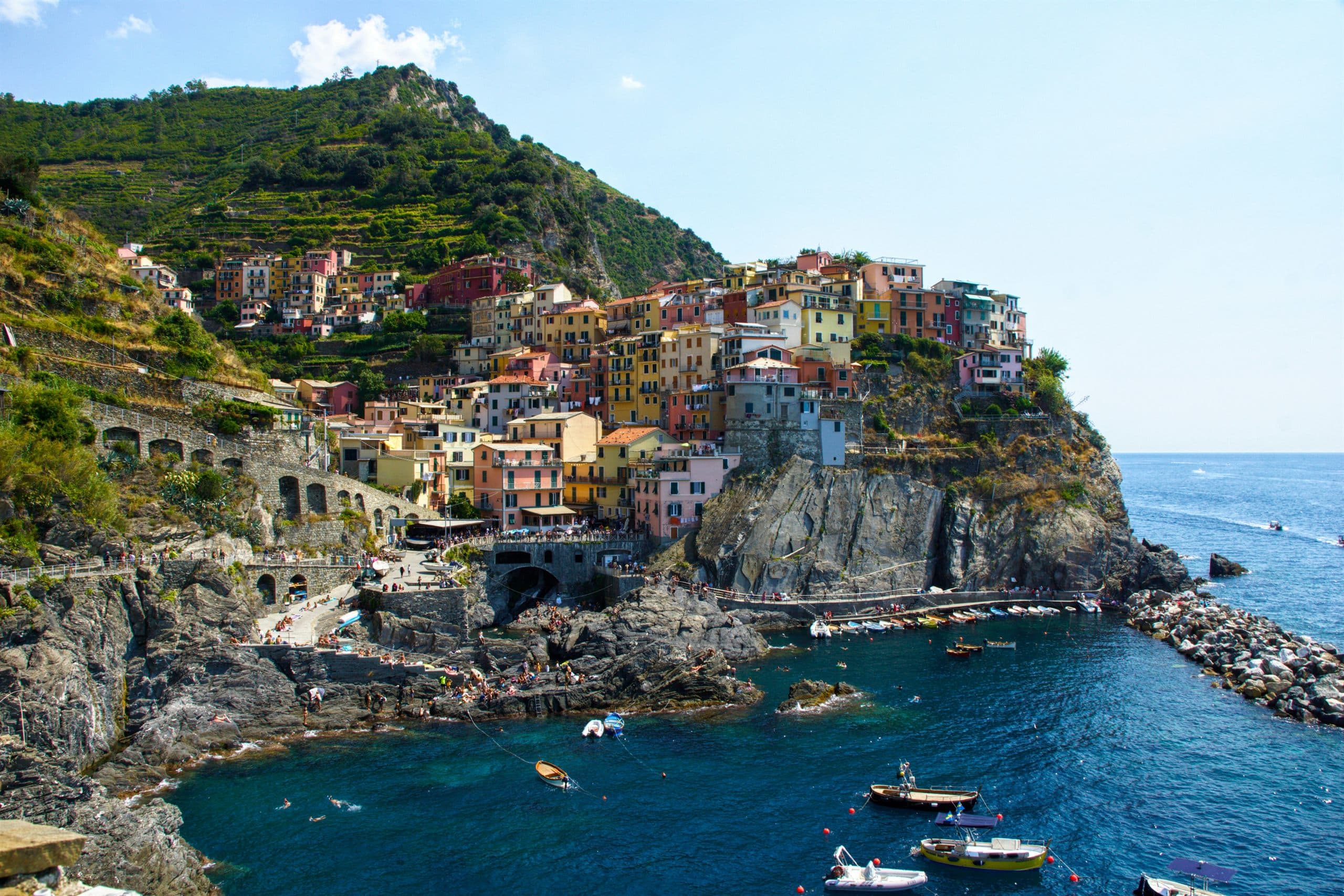
A village of pastel houses stacked on a rocky headland above a small harbour, with terraced hillsides rising behind it and boats drawn up on the slipway below.
The villages are the draw. Reaching them from Florence is the problem.

Technically possible, and a poor use of a day. This is the entry most likely to disappoint, and it is on every list because the photographs are extraordinary. The villages deserve the attention. The day trip does not.

Reaching the villages from Florence normally means changing trains on the outward and return journeys, with additional local trains if you want to see more than one village. It is possible in a day, but much of the usable time is spent in transit; Cinque Terre earns an overnight.

A day trip also puts you there in the middle of the day, which is the part of it the villages are least suited to — five small settlements on a narrow strip of coast, joined by one local line, with everyone arriving and leaving inside the same few hours.

Give it a night, or two. The Cinque Terre is a place where the good hours are early and late — the villages empty out, the light drops onto the water, and the walking between them stops being a scramble against a train you have to catch. Everything that makes it worth going is happening outside the window a day trip gives you.

If a day is genuinely all you have and you are set on going, the way to make it least bad is to pick one village rather than trying to see the five, and to accept the day as a long one. But the honest recommendation is to move it out of your Florence days and give it nights of its own on the way north or south.

Days that try to fit too much in

Some combinations are sold constantly and are worth thinking about before you commit a day to one.

Siena and San Gimignano and Chianti in one day. It is the most common organised day out of Florence and it does work — as a countryside day with two town stops. What it is not is a way to see Siena. Expect an hour or so there. If that is understood in advance it is a good day; if you booked it believing it was your Siena visit, it is not.

Pisa and Cinque Terre together. These get combined because Pisa is on the way, and the result is a very long day with two rushed stops. Pisa deserves a morning and Cinque Terre deserves a night; joined up they give you neither.

Anything with three towns and a wine tasting. The pattern to watch is a day where the drive between stops is longer than the stops. Count the places named in the description: past three, most of the day is transport with photographs at the end of it.

Two day trips back to back. The commonest mistake on a four-night Florence trip, and the one nobody sells you — it is self-inflicted. Two consecutive days out leaves the city itself as the thing you passed through between departures.

What a day trip costs you in Florence

Worth saying plainly, because most pages on this subject are written as though day trips were free. They are not. Florence is small enough to walk and dense enough that three days in it are not excessive, and every day out is one of those days spent elsewhere.

The rough shape that works: on a three-night trip, take no day trip, or one at most. On four or five nights, one is comfortable and two is the ceiling. Beyond that you are using Florence as a hotel with good rail links, which is a legitimate way to travel and a waste of the city you chose.

One practical thing that does change the arithmetic: being within walking distance of Santa Maria Novella, where nearly all of these trains leave from and where the bus station also is. On a day when you want the early departure, the difference between a ten-minute walk and a cross-city journey with a bag is the difference between catching the good train and taking the next one.

  • Things to Do in FlorenceWhat the days you keep in the city are for
  • Where to Stay in FlorenceWhich area suits an early start
  • Tuscany Wine Tours from FlorenceChoosing between organised countryside days
  • Cinque Terre Travel GuideThe villages, once you give them a night