Skip to content
MenuClose

Italy

Italy Itinerary Guide

How many places a week actually holds, the route that works for ten days, and the detours that quietly cost you two.

On this page

Almost every disappointing trip to Italy fails in the same way, and it is not the one people expect. It is not bad weather or bad food or the wrong hotel. It is a route with one place too many on it, planned by someone looking at a map that makes the country look smaller than it is.

Italy is about the length of California and it is not uniformly easy to cross. One spine of high-speed railway makes a handful of famous cities extraordinarily quick to move between; almost everywhere else is slower than the map suggests. Getting an Italy itinerary right is mostly a matter of knowing which of those two Italies each place belongs to, and then subtracting.

How long you actually need

The routes below treat seven days as six nights, ten days as nine nights, and fourteen days as thirteen nights. Arrival and departure days are still usable, but neither should be counted like an uninterrupted day in the city.

The working rule is one base for every three or four nights, and one fewer place than you think. A change of city costs most of a day once you have packed, checked out, crossed a city to a station, travelled, crossed another city, and found somewhere to leave a bag before the room is ready. Two nights somewhere is one real day there. That arithmetic, not the distance, is what decides how much fits.

  • First trip, 10 daysVenice, Florence, RomeThree cities on one line, taken in one direction, with no journey longer than about two hours.
  • A weekTwo cities, not threeRome and Florence is the strongest pairing. Adding Venice turns a good week into a tiring one.
  • Two weeksThe three, plus one regionSouth to Naples and the coast, or slow in Tuscany. One of them, chosen deliberately.
  • Anything shorterOne cityFive days is a city break. Treat it as one and it is a good trip; treat it as a tour and it is a blur.
What each trip length realistically holds, on a first visit.
Trip lengthBasesRoute that worksVerdict
5 daysOneRome, or Venice and nowhere elseA city break in Italy, not a tour of it. Own that
7 daysTwoRome and Florence, or Rome and VeniceTwo cities is the honest answer. Three is the common mistake
10 daysThreeVenice, Florence, Rome — in that orderThe classic, and the one most people should take
14 daysThree, plus one regionThe classic three, then south to Naples or slow in TuscanyAdd one thing to the ten-day route. Not two
3 weeksFour or fiveThe above, plus the south or the far northEnough to leave the spine. Still not enough for all of it

The one line that decides every Italy itinerary

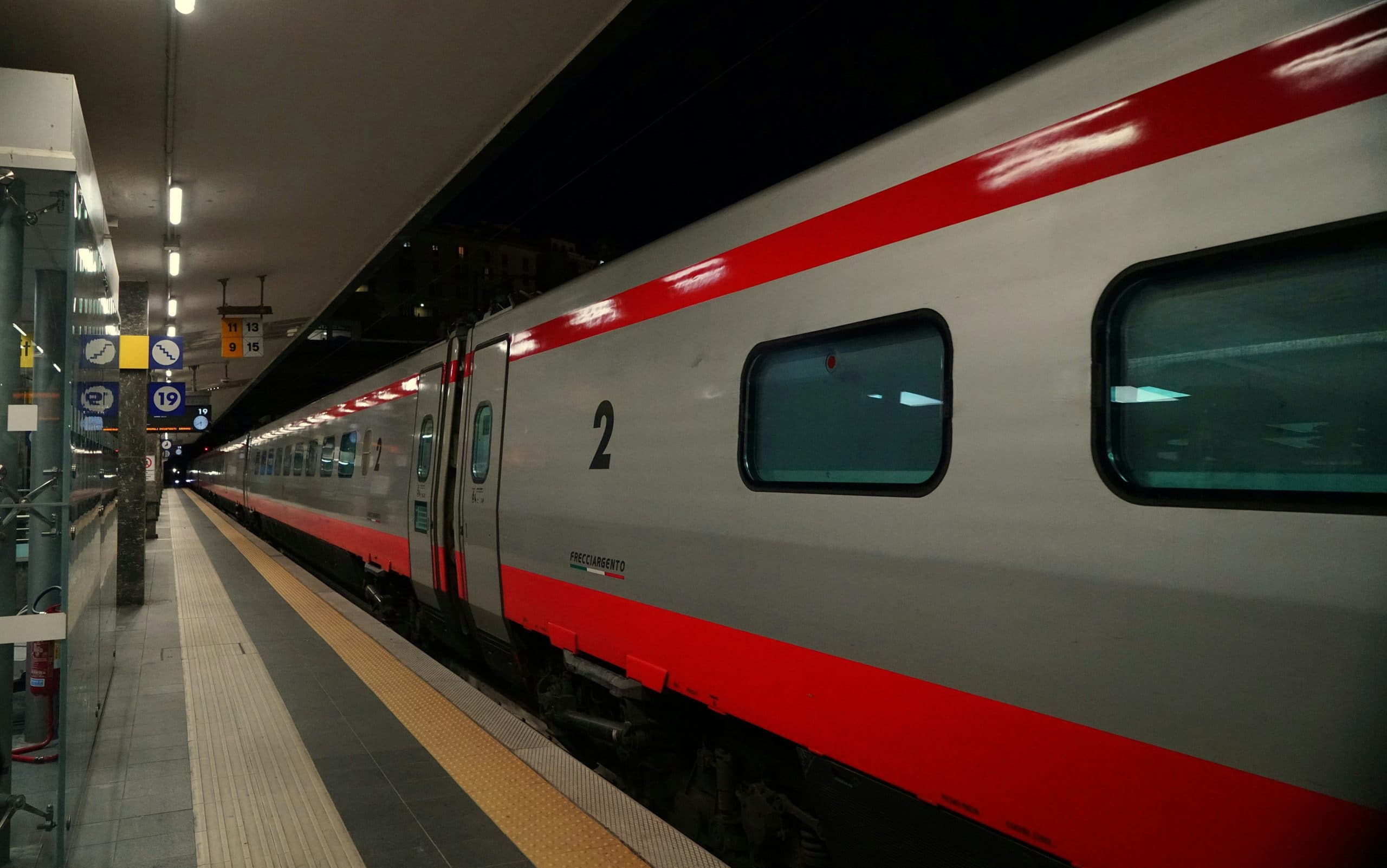
A silver and red high-speed train standing at a covered platform in an Italian station.
The spine is the itinerary. Everything else is a detour off it.

Italy has one high-speed railway that matters, and it runs roughly north to south: Turin and Milan at the top, then Bologna, Florence, Rome, Naples and Salerno. A branch leaves it at Bologna and runs through Padua to Venice. Two companies compete on the same tracks, which is why the service is frequent and why it is worth checking both.

What that means in practice is the single most useful thing to know when planning. On the spine, cities that look far apart are not: Rome to Florence is around an hour and a half, Rome to Naples about an hour, Milan to Rome about three, and Rome to Venice under four. Those are approximate and vary by service, but the shape is stable — a city on the spine is a morning away, not a day away.

Off the spine, the arithmetic changes completely. The Amalfi Coast itself has no railway. Salerno sits on the national rail network to the east, while Sorrento is reached from Naples on the separate Circumvesuviana network to the west; from either side, the final journey to the coast continues by road or, when services are operating, by water. Sicily and Puglia are genuinely far south. The Dolomites and the lakes need a regional connection and often a car. None of those is difficult. All of them cost a day at each end, and a day at each end is what a ten-day trip cannot spare twice.

So the honest way to build an Italy itinerary is to start on the spine, take it in one direction, and add at most one thing that leaves it.

The routes

7 days in Italy

Two cities. Rome and Florence. Six nights: four in Rome and two in Florence. One intercity transfer between them, an hour and a half, in the middle of the week.

Rome takes four because it is really three cities layered on one another — ancient, baroque and Vatican — and because it is large enough that crossing it is itself an event. Florence takes the squeeze because it is small and walkable enough to survive it: two nights there is one full day, which is a thin but real visit in a way that two nights in Rome is not.

The variation worth making: Rome and Venice, if Venice is the thing you have always wanted to see. It is a longer train and the two cities have nothing in common, which is either the appeal or the problem depending on the traveller.

The mistake to avoid is Venice, Florence and Rome in seven days. It is sold constantly, and the arithmetic is what rules it out: six nights divided across three bases leaves roughly two nights in each and requires two intercity transfers, on top of the arrival and departure days. Nothing is left that is not partly logistics. The same three cities in ten days is one of the best trips in Europe. In seven it is a schedule.

10 days in Italy

Venice, Florence, Rome — in that order, and this is the trip most first-time visitors should take. Nine nights: three in Venice, two in Florence, four in Rome. Two intercity transfers, both on the spine, both about two hours or less, and the whole thing moves in one direction with no backtracking.

North to south is our preferred direction, for two reasons that have nothing to do with sightseeing. It sets up an open-jaw trip — in to Venice, home from Rome — which avoids repeating a leg. And Rome is the hardest of the three to leave early in the morning, so it works better as the place you finish than the place you rush out of. Check both directions against your own origin before booking; this is a judgement about the trip, not a rule about flights.

Give Venice its evenings. Three nights sounds generous for a small city and is not, because Venice is a different place after the day visitors leave, and a two-night stay puts you there for one evening. It is the one city on this route where the marginal night changes the experience rather than adding to it — which is why Florence, not Venice, is where the ninth night comes from.

What ten days does not hold is a fourth city. Adding Naples or the Amalfi Coast to this route is the most common over-reach, and it turns a comfortable trip into one with four moves in ten days. If the south matters more than Venice, drop Venice — but do not do both.

14 days in Italy

The ten-day route, plus exactly one thing. Two weeks is enough to leave the spine once. It is not enough to leave it twice, and the trips that go wrong at this length are the ones that try.

Option one, south. Thirteen nights: the ten-day route as it stands — three in Venice, two in Florence, four in Rome — then four more for Naples and the coast. Naples is an hour from Rome on the spine, which makes it the cheapest addition on the map in terms of travel time, and it opens Pompeii and the Amalfi Coast. Give the region four nights rather than two: there is no railway along the coast, so moving within it is slower than getting to it.

Option two, slow. The same three cities, with the extra days spent in Tuscany rather than added as a fourth city — a few nights somewhere small with a car, or a longer Florence stay with days out. This is the better version for anyone who found the ten-day route appealing but the pace of it tiring.

Option three, north. Add Milan and the lakes, or the Dolomites. Honest assessment: this is the weakest of the three on a first visit, because Milan is the least rewarding of Italy’s big cities for a short stay and the mountains want more time than a fortnight leaves. It is a strong second trip.

Whichever you take, resist the instinct to make the extra week do double duty. Fourteen days with four bases is a good trip. Fourteen days with six is a travel diary.

What to leave out, and why it hurts to

Everything here is worth seeing. That is exactly why the subtraction is hard, and why it is the part of planning most worth doing deliberately rather than by accident at the airport.

The Amalfi Coast, on a first trip of ten days. It is the most common addition and the most expensive in time. There is no railway along the coast, so reaching it means the spine as far as Naples or Salerno and then a road or a boat, and moving between its towns is slower again. It rewards four or five nights and punishes two.

Cinque Terre, as a stop between cities. It looks like it sits neatly between Florence and Milan. Reaching the villages means changing onto the local line that serves them, and the good hours there are early and late — which a passing stop does not give you.

Sicily and Puglia, on anything under two weeks. Both are genuinely different from the north and both deserve their own trip. Bolting either onto a first itinerary means a flight or a very long train at each end, for a stay too short to justify it.

A car, for a city-based route. Every city on the spine has a restricted-traffic centre, parking is expensive and scarce, and the railway between them is faster than driving. A car earns its place only in the countryside — Tuscany, the lakes, the mountains — and the sane pattern is to collect one when you leave the cities and drop it before the next.

The fourth city, whatever it is. If the route already has three bases and the trip is ten days, the honest answer to “could we also fit in…” is no.

Building your own route

If none of the three routes above is quite your trip, these are the rules they are all built on.

Fly into one city and out of another. An open-jaw trip means flying into one Italian city and home from another. For the Venice–Florence–Rome route, compare arriving in Venice and departing from Rome with the reverse journey; routes and fares vary by origin and season. Returning to your arrival airport purely to fly home is the single most avoidable waste of a day.

Move in one direction. North to south or south to north, never both. A route that doubles back is spending hours to see the same landscape twice.

Three nights minimum in a city worth stopping in. Two nights is one day. If a place only justifies one day, make it a day trip from somewhere else rather than a base.

As a starting allocation for the cities on the spine: Rome four nights, because it is three cities layered on one another and large enough that crossing it costs real time; Venice three, because the third night is the one that buys you a second evening; Florence two or three — three if the trip has room, two if something has to give, because it is the city on this route that survives a single full day best; Naples three if it is a base for the region rather than a stop; and Milan one, or none. Adjust from there rather than starting from an even split — an itinerary that gives every city the same number of nights is one that has not been thought about.

Travel in the middle of the day, not the morning. A late-morning train costs you an afternoon; an early one costs you a night’s sleep and a breakfast. Moving between about eleven and three uses the part of the day that is worst for sightseeing anyway.

Decide the season before the route. When you go changes what is open and how the days feel more than which order you take the cities in — the coast and the mountains are seasonal in a way the cities are not.

Then take one thing off. Every draft itinerary has one place on it that is there because it seemed a shame to miss. That is the one.